Why So Many People Are Confused About AI Today
Artificial Intelligence is evolving so fast that most people are struggling to keep up. You’ve probably used AI already. You ask ChatGPT a question, it replies. You ask it to write an email, it writes one. That’s familiar and comfortable. But then you hear the term AI agent, and suddenly it feels like something only developers should touch. The truth is simpler. An AI agent is just an AI that does more than talk. Instead of only answering questions, it can remember things, make decisions, and take actions on your behalf. In many ways, it’s closer to a digital assistant than a chatbot. If a chatbot is someone you talk to, an AI agent is someone you assign work to.
Understanding AI Agents vs Chatbots vs Assistants isn’t just technical knowledge anymore. It’s becoming a competitive advantage – especially in 2026, where automation and intelligent systems are reshaping industries. An AI agent is a system that can understand a goal, decide what steps are needed, and then carry out those steps automatically or semi-automatically. It doesn’t just wait for your next message. It can act, pause, check results, and continue. For example, instead of asking, “How do I organize my files?” an AI agent can actually organize them. Instead of reminding you manually every day, it can remember, schedule, and notify you on its own. In simple words, an AI agent is AI + memory + actions.
If you spend even a few minutes online, you’ll see the terms AI Agents, Chatbots, and AI Assistants being used everywhere. Tech companies mention them in product launches. Startups use them in investor presentations. Influencers talk about them as if they are the same thing. But they are not the same thing.
Most people casually assume that if something talks back to you, it must be an AI assistant. Others believe that anything powered by artificial intelligence is automatically an AI agent. The confusion is understandable because these technologies overlap in some ways. However, the differences between AI Agents vs Chatbots vs Assistants are not small technical details. They represent completely different levels of intelligence and autonomy. Let’s break this down in the simplest way possible.
Why This Matters to You
This is not just a technical debate. It is an economic shift. If you only understand chatbots, you are operating at the surface level of automation. If you understand AI assistants, you are improving productivity. If you understand AI agents, you are stepping into the world of intelligent systems that can run complex processes. The difference between AI Agents vs Chatbots vs Assistants is ultimately the difference between tools that respond and systems that act with purpose.
As technology continues to evolve, the line between human strategy and machine execution will become thinner. Those who understand this transformation will be better prepared for the future. And in 2026, that understanding may not just be helpful. It may be essential.
Understanding AI Agents vs Chatbots vs Assistants at a surface level is helpful, but if you want to truly stay ahead – whether as a business owner, student, professional, or creator – you need to understand how these systems impact real-world strategy, decision-making, and long-term digital transformation. The real difference is not just technical architecture. It is about control, responsibility, risk, and scalability. Let’s explore what that means.
The Evolution That Changed Everything
Artificial intelligence did not suddenly become “smart” and AI did not jump from basic scripts to autonomous systems overnight. It evolved gradually. In the beginning, software systems were rule-based. So computers could only follow strict instructions. They did exactly what they were told and nothing more. Then they learned to respond to basic human input. Those are chatbots that could simulate conversation. After that, they became capable of performing tasks. This evolution is the key to understanding AI Agents vs Chatbots vs Assistants.
Now, we are entering an era where systems can make plans and act independently. AI assistants emerged that could perform actions on your behalf. Now, AI agents are pushing the boundary by making decisions and executing complex workflows without constant human direction. Each step added more intelligence, more independence, and more responsibility to machines.
What a Chatbot Really Is
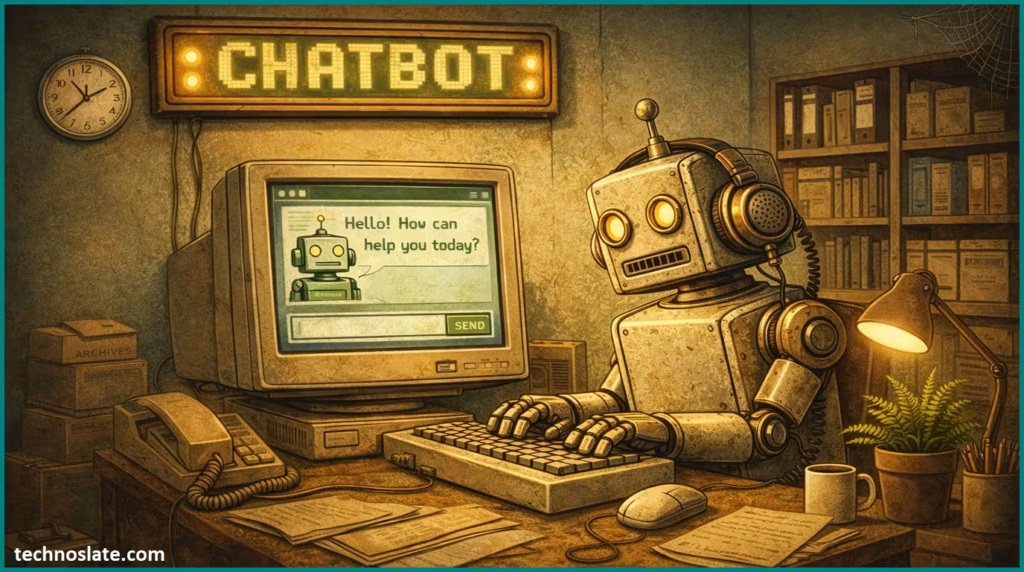
.A chatbot is essentially a conversational interface. It is designed to communicate with users through text or voice and provide responses based on user input. At its core, a chatbot exists to answer questions and guide users. Early chatbots were extremely simple. They relied on keyword matching. If you typed the exact phrase the system was programmed to recognize, you received the correct answer. If you slightly changed the wording, the system might fail completely.
Modern chatbots are more sophisticated because they use Natural Language Processing. This allows them to understand intent instead of just keywords. When someone types, “Where is my package?” or “Track my delivery,” the chatbot can recognize that both queries relate to order tracking. Even with this improvement, a chatbot remains reactive. It waits for you to say something. It responds. Then it waits again.
A chatbot does not wake up and decide to improve your marketing strategy. It does not analyze last month’s sales data and propose changes. It lives entirely within the boundaries of conversation. If you imagine a real-world scenario, a chatbot is like a receptionist at the front desk of a company. It greets visitors, answers basic questions, and directs people where they need to go. It is helpful, but it does not run operations.
What an AI Assistant Actually Does
An AI assistant goes a step further. While a chatbot focuses mainly on conversation, an assistant is designed to take action. When you ask Amazon Alexa to turn off the lights, it connects to your smart home system and performs the action. When you tell Apple Siri to call someone, it initiates the call. When you ask Google Assistant to schedule a meeting, it interacts with your calendar and books the time slot. This is where the real shift happens. An AI assistant does not just talk. It does something.
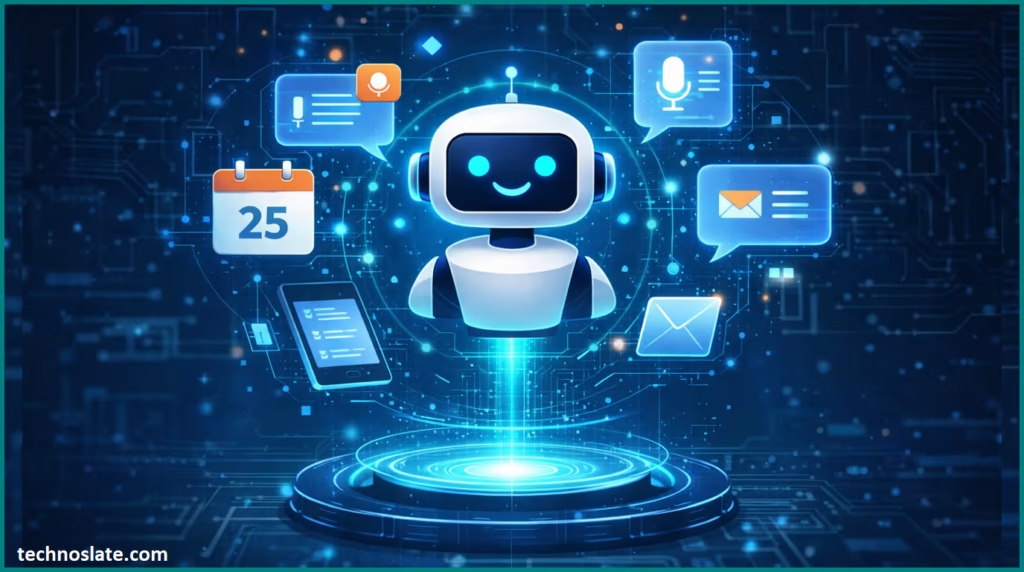
Assistants are deeply integrated with systems, applications, and devices. They can send emails, set alarms, create reminders, control appliances, and provide personalized suggestions based on your usage patterns. However, even though AI assistants feel intelligent, they are still instruction-driven. They depend on your commands. They rarely define their own goals. They do not typically create multi-step strategies on their own.
Think of an AI assistant as a highly efficient personal secretary. It works quickly and accurately. It reduces your workload. But it does not independently decide to restructure your company or launch a new product line. It assists. It does not operate autonomously.
A real-world example is Google Assistant. When you say “Hey Google, set an alarm for 7 AM and remind me to call mom tomorrow,” it understands your request and performs the actions automatically. Another example is Uber’s pricing system. Behind the scenes, AI agents analyze traffic, demand, and driver availability to adjust ride prices in real time. Similarly, companies like Amazon use AI agents to recommend products to customers based on their browsing and buying behavior.
What Makes AI Agents So Different
Now we reach the most transformative layer in the discussion of AI Agents vs Chatbots vs Assistants. An AI agent is not limited to conversation. It is not limited to executing direct commands. It is designed to achieve objectives. If you give an AI agent a high-level goal, it can break that goal into smaller tasks, determine the order of execution, select appropriate tools, perform actions, evaluate outcomes, and adjust its approach if necessary.
An AI agent usually does three main things. First, it observes information. This could be data from the internet, user input, or files. Second, it thinks and decides what to do using AI models. Third, it takes action, like sending a message, generating a report, or performing a task in another app. People benefit from AI agents because they save time, reduce manual work, and help make better decisions. For example, a business owner can use an AI agent to automatically reply to customer emails. A marketer can use one to research competitors and generate reports. A student can use an AI agent to summarize long articles or organize study notes.
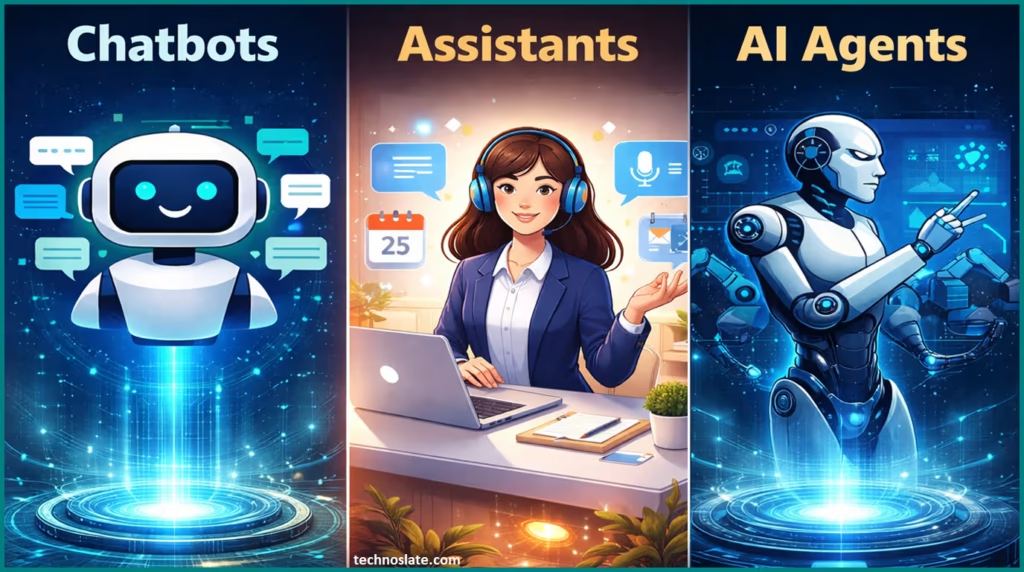
An AI agent operates in a loop. It observes the environment, makes a plan, takes action, evaluates results, and refines its strategy. This continuous improvement cycle makes it closer to a digital employee than a simple software tool. If a chatbot is a receptionist and an assistant is a secretary, then an AI agent is an operations manager. It thinks in terms of goals and outcomes rather than simple tasks. When discussing AI Agents vs Chatbots vs Assistants, the most important distinction lies in autonomy.
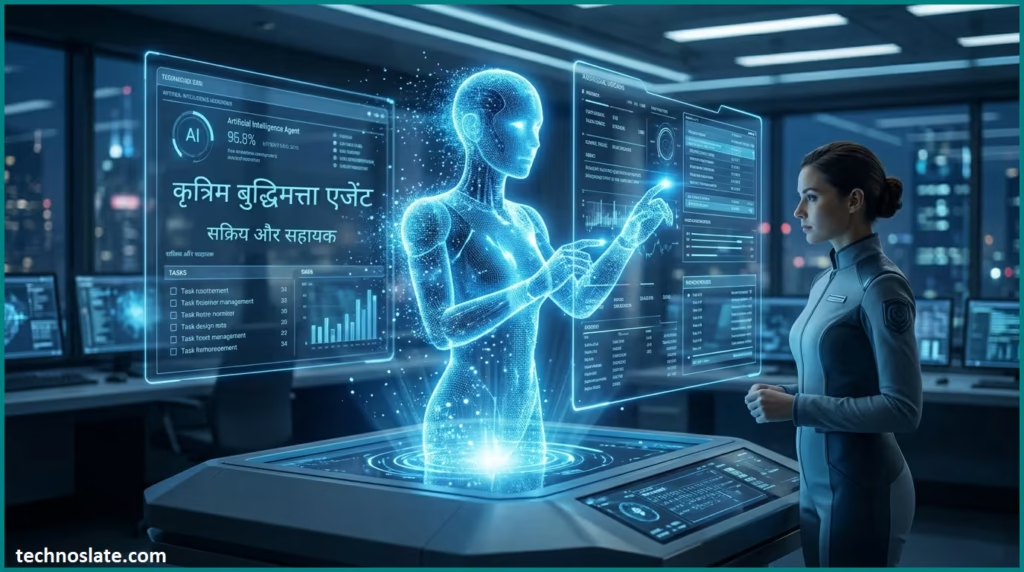
For example, imagine telling an AI agent to research a new business opportunity. Instead of waiting for detailed step-by-step instructions, the agent could gather market data, analyze competitors, evaluate pricing models, identify potential risks, and present a structured strategy. This ability to plan and adapt is what separates AI agents from chatbots and assistants.
- A chatbot has conversational intelligence. It understands language patterns and generates responses.
- An AI assistant has functional intelligence. It connects commands to actions.
- An AI agent has strategic intelligence. It understands objectives and creates execution pathways.
How Businesses Use Each System
In the real world, chatbots are commonly used in customer support. They answer frequently asked questions, help with order tracking, and reduce the workload on human support teams. They are cost-effective and available around the clock. AI assistants are often used to enhance productivity. They manage schedules, organize reminders, and streamline communication. In corporate environments, they help professionals save time.
AI agents, however, are entering areas that require decision-making and strategic thinking. Companies are exploring their use in marketing automation, financial forecasting, research analysis, supply chain optimization, and workflow automation. This is where the future is shifting. Organizations are no longer asking, “How can we automate replies?” They are asking, “How can we automate decision-making?” That question leads directly to AI agents.
Looking ahead to 2026, the conversation around AI Agents vs Chatbots vs Assistants will become even more important. Chatbots will not disappear because simple solutions are always valuable. AI assistants will continue to improve as personalization becomes more advanced. However, AI agents are expected to grow rapidly because businesses want scalable intelligence. They want systems that reduce operational costs while increasing efficiency. Autonomous AI systems align perfectly with that goal. The companies that understand this shift early will have a competitive advantage. The individuals who learn how to design, manage, and supervise AI agents will find themselves in high demand.
The Responsibility Gap: Who Is Actually “In Charge”?
One of the most overlooked aspects when discussing AI Agents vs Chatbots vs Assistants is responsibility. A chatbot does not carry responsibility. It answers questions within a limited scope. If it fails, the impact is usually minor. Maybe a customer gets slightly frustrated. Maybe someone has to contact human support instead.
An AI assistant carries slightly more responsibility because it performs actions. If it schedules a meeting incorrectly or sends a message to the wrong person, there are consequences. However, those consequences are still limited because the assistant operates under direct instruction.
An AI agent, on the other hand, introduces a new level of responsibility. When a system is capable of planning, choosing tools, executing multi-step processes, and adapting strategies, the stakes increase. If an autonomous agent is managing marketing budgets, optimizing supply chains, or analyzing financial models, its decisions influence real outcomes. This is where governance, monitoring, and human oversight become essential. The conversation about AI Agents vs Chatbots vs Assistants is no longer just about capability. It is about accountability.
With greater power comes greater complexity. Chatbots are relatively safe because their capabilities are narrow. They operate within a predefined conversational boundary. AI assistants introduce moderate complexity because they integrate with devices and applications. They need permission systems and safeguards. AI agents introduce a much broader operational scope. Because they can plan and execute independently, they require structured constraints, ethical frameworks, and ongoing monitoring.
Organizations adopting AI agents must think carefully about guardrails. They need clear limits on what the system can access, how it evaluates decisions, and how it escalates uncertain situations to humans. This layer of strategic oversight is what separates experimental automation from enterprise-grade autonomy. In the future, discussions around AI Agents vs Chatbots vs Assistants will increasingly focus on regulation and responsible deployment.
Career Implications in 2026 and Beyond
There is another layer to this conversation that often gets ignored: entrepreneurship. When chatbots first became popular, agencies began offering chatbot development services. Businesses were willing to pay for automation that reduced support costs. When AI assistants matured, productivity apps and integrations exploded in the market. Now, AI agents are opening new doors.
However, history shows that automation does not eliminate opportunity. It redistributes it. As AI agents become more common, demand grows for people who understand how to design, supervise, optimize, and govern them. Roles focused on AI operations, workflow design, AI ethics, automation architecture, and human-AI collaboration are expanding. The rise of AI Agents vs Chatbots vs Assistants is not just about corporate transformation. It is about startup creation.
Entrepreneurs can build niche automation services powered by autonomous agents. They can design AI-driven research systems, marketing automation engines, financial planning assistants, or industry-specific decision platforms. The opportunity lies in specialization. While general-purpose AI agents are powerful, businesses often need customized workflows tailored to their industry. This is where innovation happens.
Understanding AI Agents vs Chatbots vs Assistants is no longer just technical knowledge. It is career positioning. The professionals who understand how to work with autonomous systems instead of competing against them will be more resilient in the long run.
As systems become more autonomous, ethical questions become more complex. Chatbots rarely raise deep ethical concerns because they mainly provide information. AI assistants raise moderate concerns around data privacy and permissions. AI agents raise fundamental questions about decision authority, bias, transparency, and long-term societal impact.
If an autonomous system makes a financial decision that affects thousands of people, who is responsible? If it optimizes processes in a way that unintentionally creates inequality, how do we correct it? These are not theoretical questions. They are already being discussed in research communities and policy circles. The deeper you go into AI Agents vs Chatbots vs Assistants, the more you realize that this is not just a technical comparison. It is a societal conversation.
Advantages of AI Agents
One of the biggest advantages of AI agents is that they reduce mental load. You don’t have to remember everything yourself. The agent can track tasks, deadlines, routines, and reminders, which makes daily life feel less overwhelming. AI agents also save time by handling repetitive work. Tasks like sending reminders, organizing files, checking updates, or summarizing information can happen automatically in the background.
Another advantage is consistency. Humans forget, get tired, or procrastinate. AI agents don’t. Once set up correctly, they perform tasks the same way every time. AI agents can also personalize themselves over time. The more they interact with you, the better they understand your preferences, habits, and priorities, making their help more relevant and less generic.
Disadvantages of AI Agents
AI agents are powerful, but that power comes with responsibility. One major downside is that they can make mistakes if instructions are unclear. Unlike humans, they don’t understand intent emotionally – they follow logic. Another challenge is setup. Many AI agents are not “install and forget.” They require configuration, testing, and occasional maintenance. For casual users, this can feel intimidating at first.
There’s also the risk of over-dependence. Some users start relying too heavily on agents and stop double-checking important actions. This can be risky, especially for tasks involving money, data, or privacy. Finally, AI agents are only as good as the data and permissions they’re given. If access is too limited, they feel useless. If access is too broad, they can cause damage if something goes wrong.
Common Use Cases of AI Agents
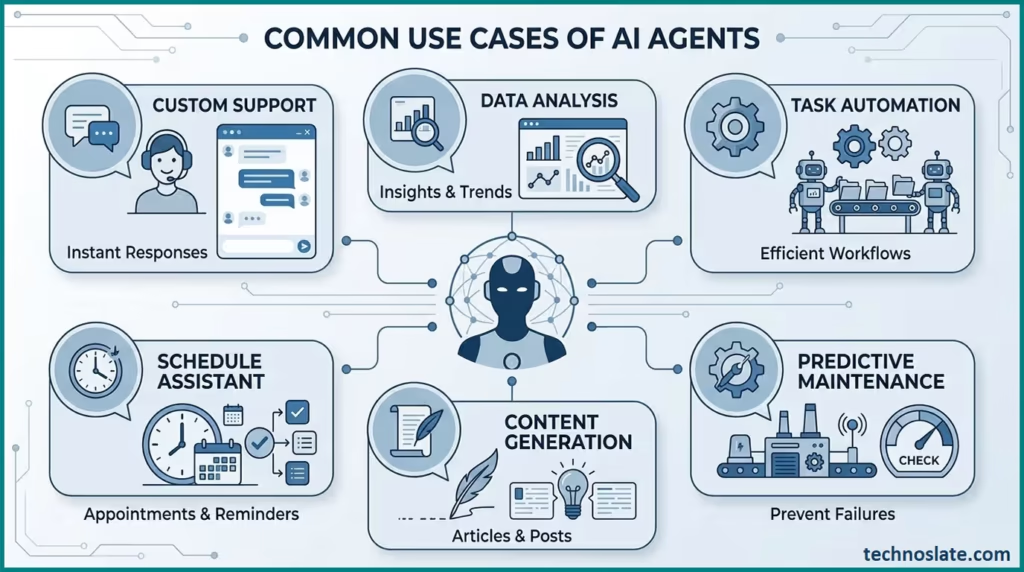
AI agents are commonly used for personal productivity. They manage reminders, to-do lists, schedules, and daily routines, helping users stay organized without constant effort. Many people use AI agents for digital housekeeping, such as organizing files, sorting emails, or monitoring system tasks. This is especially helpful for people who dislike repetitive digital chores.
AI agents are also used in learning and research. They can track study goals, summarize information, and help maintain focus over long-term projects. Some users use AI agents for home automation or remote control tasks, where the agent responds to messages and triggers actions like starting backups or checking system status.
Real Life Examples
First, imagine you are someone who likes to stay updated with news or trends in your field. You could build a Daily News AI Agent. This agent wakes up every morning, searches the internet for the latest news about a topic you care about, summarizes the important points, and sends them to you in an email or message. Instead of spending 30 minutes scrolling through websites, you get a clean summary in a few seconds. Many people build this type of agent using tools connected with ChatGPT.
Now imagine you run a small business or sell products online. You could build a Customer Reply AI Agent. Customers often ask the same questions like “What is the price?” or “When will my order arrive?”. An AI agent can read incoming messages and automatically send helpful replies based on your business information. This saves hours of customer support work. Platforms like Zapier allow you to connect AI with email, WhatsApp, or forms so the agent can respond automatically.
Another very useful one is a Price Tracking AI Agent. Suppose you want to buy a phone or laptop but want the best deal. Instead of checking prices every day, the AI agent monitors different websites and alerts you when the price drops. For example, it could track a phone like the Apple iPhone 15 and notify you when a store offers a discount. Many smart shoppers use this kind of automation to save money.
Students can create something called a Study Helper AI Agent. This agent reads long articles, PDFs, or lecture notes and turns them into simple summaries. It can also generate quizzes so you can test yourself before exams. For example, if you are studying topics in Computer Science, the agent can summarize chapters and explain concepts in simple language.
Content creators often build a Content Idea AI Agent. This agent looks at trending topics on the internet and suggests ideas for posts, videos, or blogs. If you are creating content on platforms like YouTube, the agent can find trending topics, generate titles, and even help outline a script.
The biggest benefit of these AI agents is that they save time, reduce boring work, and help you stay organized. Instead of manually searching, reading, replying, or tracking things, your agent quietly does it in the background.
In simple words, AI agents are like small digital workers you hire once and they keep working for you every day. People use them for business, studying, shopping, and content creation.
How to Use an AI Agent
Using an AI agent starts with clarity. You need to know what problem you want it to solve. Vague goals lead to confusing results. Simple, specific tasks work best in the beginning. Once set up, you interact with the agent using natural language, but with clarity. Instead of giving emotional or abstract instructions, you describe actions and outcomes clearly.
It’s important to monitor the agent early on. Watch how it behaves, correct it when needed, and refine instructions gradually. Think of it like training a new assistant rather than commanding a robot. Over time, as trust builds, the agent can be given more autonomy. But that trust should be earned, not assumed.
For beginners, the best approach is to start small. One task, one workflow, one goal. Success with a simple task builds confidence and understanding. Clear communication matters more than clever prompts. AI agents perform better with direct, structured instructions than with vague or emotional language. Beginners should always keep backups and safety limits in place. This prevents small mistakes from becoming big problems. It also helps to treat AI agents as helpers, not decision-makers. Let them handle execution, not judgment – especially at the start.
Common Beginner Mistakes and Their Solutions
- One common mistake is expecting the AI agent to “just know” what you want. The solution is to be explicit and patient. Clarity beats intelligence.
- Another mistake is giving too much power too quickly. The solution is gradual permission expansion, starting with low-risk tasks.
- Many beginners stop monitoring too soon. The solution is regular check-ins, especially during the early days.
- Some users copy configurations without understanding them. The solution is learning the basics of what each setting does, even at a high level.
Which One Is Best for Casual Users?
At the surface level, the discussion of AI Agents vs Chatbots vs Assistants seems like a simple technology comparison. But at a deeper level, it reflects the evolution of machine intelligence. We are moving from systems that respond, to systems that assist, to systems that operate. That progression is redefining productivity, business strategy, and even how humans think about work.
The real power of understanding these systems is not in memorizing definitions. It is in recognizing how autonomy changes everything. When machines move from answering questions to executing plans, the world shifts. And the people who understand that shift early will not just adapt to the future. They will help shape it.
For most casual users, chatbots are the easiest starting point. They require no setup and give instant value. AI assistants work well for daily convenience but don’t scale much beyond simple tasks. AI agents are powerful, but they require patience and learning. Casual users who enjoy experimenting and improving systems over time will benefit the most. There’s no rule that says you must choose only one. Many people use all three for different purposes.
Yes, but only if the expectations are realistic. AI agents are not magic. They don’t replace thinking, planning, or responsibility. They assist, automate, and support. Casual users who enjoy learning, experimenting, and improving systems will benefit the most. Users who want instant perfection may feel frustrated.
Summary for AI Agents vs Chatbots vs Assistants
Chatbots: Good at Talking, Bad at Doing
Chatbots like ChatGPT are conversation-focused. You ask a question, they answer. You ask for text, they generate it. Once the conversation ends, most context disappears. Chatbots are great when you want information, explanations, ideas, or writing help. They are reactive, not proactive. They don’t wake up on their own and do things for you. Think of a chatbot as a very smart friend who gives advice but never takes action.
AI Assistants: Helpful, but Limited
AI assistants like Siri or Google Assistant sit somewhere in the middle. They can set alarms, send messages, or check the weather. They are action-oriented but limited to predefined tasks. They work best for quick commands and voice interactions. However, they don’t deeply understand long-term goals, and they don’t adapt much over time. An assistant is like a receptionist. Useful, fast, but not deeply involved in your life.
AI Agents: Ongoing Helpers That Work for You
AI agents go a step further. They combine conversation, memory, and action. You don’t just ask them questions – you give them responsibilities. An AI agent remembers past instructions, tracks progress, makes decisions within limits, and performs tasks even when you’re not actively chatting with it. Think of an AI agent as a junior assistant you manage. You don’t micromanage every step, but you still supervise important decisions.
FAQs on AI Agents vs Chatbots vs Assistants
- Can AI agents work without the internet?
- Some parts can, but most useful features rely on internet access, especially language models and messaging integrations.
- Are AI agents dangerous?
- They’re not dangerous by default, but misuse or poor configuration can cause problems. Safety depends on how they’re set up.
- Do I need coding skills to use an AI agent?
- Not always. Many tools are becoming more user-friendly, but basic technical comfort helps.
- Can an AI agent replace human assistants?
- For repetitive digital tasks, yes. For emotional understanding and judgment, no.
- Will AI agents become mainstream?
- Yes, but slowly. As interfaces improve, more casual users will adopt them.
- What’s the biggest misconception about AI agents?
- That they think like humans. They don’t. They follow logic and instructions.
Final Thoughts on AI Agents vs Chatbots vs Assistants
AI agents are not the future – they’re already here. The real question is not whether they’re powerful, but whether you’re ready to use that power responsibly. For casual users, AI agents can be incredibly helpful when treated as assistants, not replacements. Start small, stay curious, and let learning happen naturally. That’s when AI agents stop feeling scary and start feeling useful.
I hope this article helped you to get understanding about AI Agents vs Chatbots vs Assistants. If this post helped you then please share it with your friends and family to know about it. If you have any questions then feel free to ask in comment section. We will try our best to help you. You can read more such interesting articles here.